
Abortion and Lies

Lies.jpg


Sunday I preached on abortion for Sanctity of Human Life Sunday. We have done this since we planted the church. Each year we try to look from a different angle at the issue to provide Biblical truth and also cultural insight.  This is always done with the perspective of the gospel in mind. The deep change that we need to recover from the wounds of abortion and be reconciled to God can come only through the message of His grace in Jesus Christ.

This year we looked at some of the great lies that abortion culture is built on.

Below is one of the stories I quoted in the message that you can listen to here.   You can (and should) read more about the long list of abortion providers that gave up their work after seeing what it was really all about. This comes from the Human Life Review.

"At least one clinic worker, nurse Brenda Pratt Shafer, turned against abortion almost immediately after witnessing a partial-birth abortion. (This is also called a “D&X” abortion for “dilation and extraction.”) Shafer, who was “very pro-choice” at the time, accepted a temporary agency’s assignment to Dr. Martin Haskell’s abortion clinic in Dayton, Ohio, in 1993. On her third day at the clinic, she observed the D&X abortion of a Down Syndrome baby in the sixth month of gestation. She saw Haskell deliver most of the little boy’s body, keeping only his head inside the womb:

The baby’s little fingers were clasping and unclasping, and his little feet were kicking. Then the doctor stuck the [surgical] scissors in the back of his head, and the baby’s arms jerked out . . .

The doctor opened up the scissors, stuck a high-powered suction tube into the opening, and sucked the baby’s brains out. Now the baby went completely limp. I was really completely unprepared for what I was seeing. I almost threw up as I watched Dr. Haskell doing these things. . . .

The woman wanted to see her baby, so they cleaned up the baby and put it in a blanket and handed it to her. She cried the whole time. She kept saying, “I am so sorry, please forgive me.” I was crying, too. I couldn’t take it."

After my message, one of the ladies at church came up to me and asked, with incredulity, "how could anyone who knows that this happens still support abortion?" And the answer is that most people don't know what really happens. I have done outreach on college campuses and discussed this. Most students don't understand what is going on. The evil and moral corruption of abortion can only survive when it is shrouded by deceit and darkness.  Advocates of abortion cannot speak about the dignity and life of the child. The discussion is shrouded in medical and political euphemisms.  And the sad thing is that these lies don't only take the lives of children, they harm women as well. Indeed a great many women go along with abortion because they are lied to.  You can listen to the whole message here. 

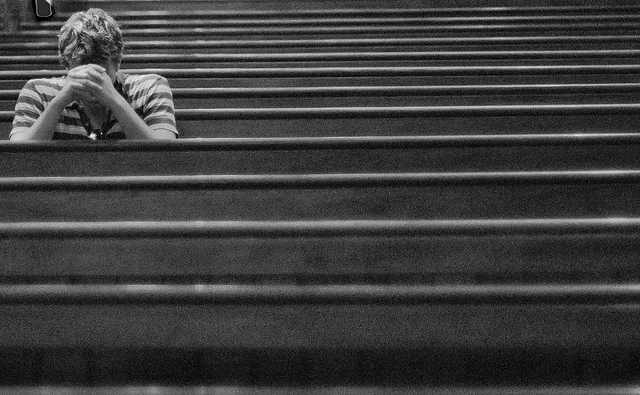
Photo used by permission Ged Carroll. Some rights reserved.

God and The Reasonable Person Standard

When I worked in healthcare I was told that if I ever made a mistake, especially one that might harm someone, that I would be judged by the “reasonable person standard.”  What that means is that a person’s conduct would be evaluated against based on this concept: What would a reasonable person with similar training and experience do in your circumstances? If what you did was in line with what a thinking person with your certification might do, then even if some harm followed you would be cleared. Your decision wouldn’t be considered an act of negligence.

I was recently reading the book American Sketches by Walter Isaacson. In one of the essays he mentioned that Albert Einstein famously remarked to a friend, “When I am judging a theory, I ask myself whether, if I were God, I would have arranged the world in such a way.” We may speculate on the larger context and meaning of the statement. But it made me think about this idea: “If I were God, would I have done it this way?”

The implication here is really applying the form of the reasonable person standard to God. Take 100 other intelligent, wise, compassionate people and ask them how they would have made the world. If their answer is different than what we see, then we must conclude that God is somehow negligent. This is the way we often deal with suffering and evil in the world. It is easy for us to conclude that God got it wrong, because we would have done it different if we were in charge.

Lay people do this all the time to the “experts” and it is now more visible than ever.  Social media makes it easy for us to publish our condemnation of coaches, referees, engineers, police officers, surgeons, generals, judges, pilots, etc.  With little consequence we can broadcast our “informed opinions” about all these people and their decisions. Of course, few of us fit into the “reasonable person” standard when compared to these people. We don’t have their training. We don’t have their experience. We haven’t had the privilege of their mentors. We don’t know the rules and guidelines of their profession.  And we aren’t liable to suffer the consequences of their decisions either. What we do have is a meme, or a 30 second sound bite with which to judge them. Somehow this makes us the standard. And it is laughable how often we are wrong. When the full story is revealed many of the most criticized decisions end up being the right ones.

We also do this to God.  We can say with Einstein, “If I were God…” But is there really a more arrogant statement?  What we should really say is: “If I knew absolutely everything, including the past and the future… If I could see into people’s motives and heart dispositions… If I was able to perfectly balance the interests of all things in the right proportion… then I would have done things different.” But that isn’t true.  You aren’t God and neither am I.  You can’t even master 1/100th of all there is to know in any one academic or scientific discipline, let alone all of them. 

But God does know it all, and has gracious purposes.  He has made this clear in sending Jesus to enter our world and suffer on our behalf. He has withheld nothing from us, no matter the cost. Though his gracious purposes include a world of brokenness and evil, we can trust that if we knew what God knew, we wouldn’t criticize. We would just stand in awe. And one day we will. But he hasn't done it the way we would have done it.  But since most of us have trouble balancing our checkbooks and keeping a few resolutions for the New Year, it is more reasonable to trust that the one who framed the all the wonders of the world-great and small-is more qualified than we are. We should stop acting like we are the reasonable person standard for God.


Unanswered Prayer

A great question came up on Sunday as we did an extended time of answering questions on prayer.  The first message on prayer can be found here. That message was an argument for spending more time with God in prayer in the New Year. We had so many great questions on that first Sunday that we decided to take the next Sunday to answer them. You can find the second session audio here.

The question that came up is this: What do you do when you don’t believe that God is going to answer your prayer? And some of this has to do with coming to grips that God may not, and at times probably won’t answer your prayer the way you are asking.   This is a tough question and one that goes to the root of our faith and view of God. It is NOT simply an academic exercise. It involves times where we are praying for legitimate things—like the life of loved ones—and he does not answer our prayers…. At least the way we asked.

The main text we looked at on Sunday was from Matthew 7:7-11 (ESV)

“7 “Ask, and it will be given to you; seek, and you will find; knock, and it will be opened to you. For everyone who asks receives, and the one who seeks finds, and to the one who knocks it will be opened. Or which one of you, if his son asks him for bread, will give him a stone? 10 Or if he asks for a fish, will give him a serpent? 11 If you then, who are evil, know how to give good gifts to your children, how much more will your Father who is in heaven give good things to those who ask him!”

I believe this passage provides one of the best frameworks for understanding the heart of God in prayer:  that of a generous and loving parent. This perspective says that we should come to God with confidence because he is far more generous and good than the best human parent. And most parents I know LOVE to give their children good gifts. There is little that is more satisfying than seeing your children enjoy and delight in the gifts you give them. This is why Jesus can promise that everyone that asks receives, everyone that seeks finds, and everyone that knocks will have the door open to them. This promise is certainly expansive. But it is not a blank check for us to demand anything our heart desires. I found this out as a teenager when my prayers for a jet pack were not answered. Ridiculous, isn’t it. Almost as ridiculous as some of the things we pray for as adults.

Jesus’ illustration helps us to come to God with confidence, but it also explains why so often God does not immediately answer our prayers. He said it would be unthinkable for a father to give his son a snake when he asks for a fish. True. The reverse is also true. If his son asks for a snake, either knowingly or unknowingly, his father is not going to march down to Rattlesnake Depot to get junior a new pet. It would be BAD for the child.

Sometimes we ask for things that are bad for us. Or it may be that we are asking for something too soon. We are not yet ready to handle it. Last week a 2 year old at Walmart in Idaho got ahold of the gun in his mother’s purse and killed her.  If we are honest, there are times when we have asked God for a loaded gun, and he graciously said NO.  Or maybe he said, “not yet.” Maybe that gift comes 15 years later when you are ready for it.

But what about the times when we aren’t asking for a gun or a rattlesnake? What about the times when we are asking for something good? Like the healing of a child or spouse? What about the times when God doesn’t answer those requests? What about the fear that we have when we come to him in those situations?

This is where we must bow low and appreciate both his gracious heart and his wise plan. His ways are not our ways. And there are times when parents decide not to give their children even good things for reasons the child may not understand. But isn’t it funny how time, experience, and maturity changes our perspective? There are plenty of times I shook my fist at my parents for telling me “NO.” As a teenager those denials felt like tyranny. Now they make perfect sense.  The fact that my dad said “no,” or “wait” are evidence that he was a good father and that he loved me.  And I am actually better off because of what he did. 

Recently my own son was going to take some Motrin for a headache. He asked me how often he could take the medicine. I have a background in healthcare. I definitely know the answer. But he was holding the bottle in his hand, and so I did not tell him the answer. I told him to read the label for himself. At that moment there was a chance for my son to overcome a streak of laziness and learn how to find important information on his own. He may have rolled his eyes at me, but I didn’t give in.

God has a great heart for us. He delights to answer our prayers. He is also a wise parent and his plan for us is sometimes far different, and far more glorious than our plan for us.   What we need to believe is that our God--the one that framed the galaxies--knows more and better than we do.  He has a plan that includes many joys, but also includes many difficulties. Those parts of his plan are not an accident. They are just as much a part of his gracious heart as the times of ease and plenty. Good doctors frequently put their patients through pain in order to help them heal.

He is also a wise parent and his plan for us is sometimes far different, and far more glorious than our plan for us.

And this is where we ought to remember that prayer is NOT just about changing our circumstances. Sometimes it is about changing us. Sometimes it is about seeking God for grace and strength to love and trust him through the difficult parts of his life.  God’s people must learn to pray, “Nevertheless, thy will be done.” (Matt 26:42, 2 Cor. 12:7-9)

Photo used with permission Nathan Gibbs. Some rights reserved

Resources For Prayer

Sunday we looked at God’s word and my goal was that you would make it your resolution to pray more in 2015. We had lots of great questions and the sermon will be uploaded soon. We are planning to deal with this topic again this coming Sunday because it seems there is more to say, and you have lots of lingering concerns.

I had a handout to encourage you in some practical areas of prayer. You can download the handout here. 

I referenced a few resources and wanted to share them with you:

The Handbook for Prayer by Kenneth Boa is available on Amazon Kindle for around $10, if you want a hardcopy you can buy it at his website here for more money. I bought a used one for cheap on Ebay. But there aren't a lot of those floating around.

I mentioned the ACTS prayer method. If you want to explore this more, RC Sproul has this to say 

Pastor Matt


Photo by Dopiaza used by permission, some rights reserved

Luther on Matthew 2 & the Magi

"We see here how Christ has three kinds of disciples.

  1. The priests and scribes, who know the Scripture and teach it to everybody, and do not come up to it themselves.
  2. Herod, who believes the Scripture, that Christ is now born; and yet goes right against it, trying to prevent what it says from being done.  
  3. The pious Magi, who left country and house and home, and made it their one concern to find Christ."

Quoted in: Broadus, John Albert. Commentary on Matthew. Grand Rapids, MI: Kregel Publications, 1990. Http://www.studylight.org/commentaries/jbm/print.cgi?bk=39&ch=2&vs=1. Studylight.org. Web.

Douglas Moo On Misunderstanding James 4 in Planning and Profit

We are going through the book of James on Sunday mornings and this is a good place to share some extra meat and scraps from the table:

"However, we need to guard against a misinterpretation at this point. It would be terribly tempting (and some interpreters have succumbed to the temptation) to find here a rebuke of those who are out to make a profit at all. The economic system we call capitalism, in other words, might be the real target of James’s polemic. But, whatever we might think about the compatibility of Christianity and the profit motive of capitalism, it would be wrong to find any critique here. As the following verses make clear, James is not rebuking these merchants for their plans or even for their desire to make a profit. He rebukes them rather for the this-worldly self-confidence that they exhibit in pursuing these goals—a danger, it must be said, to which businesspeople are particularly susceptible. And we should guard here against another kind of misinterpretation: the idea that James is forbidding Christians from all forms of planning or of concern for the future. Taking out life insurance and saving for retirement, for instance, are not condemned by James; these may very well be a form of wise stewardship. What James rebukes here, as v. 16 will make clear, is any kind of planning for the future that stems from human arrogance in our ability to determine the course of future events."

Moo, Douglas J. The Letter of James. Grand Rapids, MI; Leicester, England: Eerdmans; Apollos, 2000. Print. The Pillar New Testament Commentary.

Dare To Be A Sinner… You Actually Already Are!

“Confess your faults one to another” (James 5:16). He who is alone with his sin is utterly alone. It may be that Christians, notwithstanding corporate worship, common prayer, and all their fellowship in service, may still be left to their loneliness. The final break-through to fellowship does not occur, because, though they have fellowship with one another as believers and as devout people, they do not have fellowship as the undevout, as sinners. The pious fellowship permits no one to be a sinner. So everybody must conceal his sin from himself and from the fellowship. We dare not be sinners. Many Christians are unthinkably horrified when a real sinner is suddenly discovered among the righteous. So we remain alone with our sin, living in lies and hypocrisy. The fact is that we are sinners!

"But it is the grace of the Gospel, which is so hard for the pious to understand, that it confronts us with the truth and says: You are a sinner, a great, desperate sinner; now come, as the sinner that you are, to God who loves you. He wants you as you are; He does not want anything from you, a sacrifice, a work; He wants you alone. “My son, give me thine heart” (Prov. 23.26). God has come to you to save the sinner. Be glad! This message is liberation through truth. You can hide nothing from God. The mask you wear before men will do you no good before Him. He wants to see you as you are, He wants to be gracious to you. You do not have to go on lying to yourself and your brothers, as if you were without sin; you can dare to be a sinner...

"In confession the break-through to community takes place. Sin demands to have a man by himself. It withdraws him from the community. The more isolated a person is, the more destructive will be the power of sin over him, and the more deeply he becomes involved in it, the more disastrous is his isolation. Sin wants to remain unknown. It shuns the light. In the darkness of the unexpressed it poisons the whole being of a person. This can happen even in the midst of a pious community. In confession the light of the Gospel breaks into darkness and seclusion of the heart. The sin must be brought into the light. The unexpressed must be openly spoken and acknowledged. All that is secret and hidden is made manifest. It is a hard struggle until the sin is openly admitted. But God breaks the gates of brass and bars of iron (Ps. 107:16).

"Since the confession of sin is made in the presence of a Christian brother, the last stronghold of self-justification is abandoned. The sinner surrenders; he gives up all his evil. He gives his heart to God, and he finds the forgiveness of all his sin in the fellowship of Jesus Christ and his brother.

"The expressed, acknowledged sin has lost all its power."

Dietrich Bonhoeffer, Life Together