God And Football Part I: Facing Our Obsession

By Pastor Matt Troupe
Football is a lot of fun. I am writing this on a fall Saturday, and I plan on watching some college football today. Last night I attended a high school football game with my son. He is in the marching band and I was one of the chaperones for the game. I love hearing the fight songs and cheering the team. In the past couple of weeks I attended 2 Fresno State home games. I really like football. So I am going to speak up about being obsessed with football not as an angry critic but as a lover of the game. Please hear me out.
Is it possible to love something too much? Is it possible to love even a good thing too much? Clearly the answer is yes. As an example, money is a good thing, and you can do a lot of important things with money, such as paying your bills, feeding your kids, being generous to the poor, etc. But is it possible to love money (a good thing) so much that it becomes a bad thing? Yes, if your efforts to earn or keep money come before your love of God (or even your family), then you have managed to turn it into a god-substitute. And this is a serious problem. Though often misquoted, this passage is still true, “The love of money is a root of all kinds of evils.” (I Tim 6:10, ESV) It is a short step from the love of money to the dark side. People that serve money are often willing to lie, cheat, steal, and even kill for it. What we love will always shape our lives, and in this, the love of football can be like the love of money. Though it may not lead to murder, (though it has lead some fans to assault on several occasions, see here, and here for recent examples) it can lead to other evils.

Tomorrow is Sunday, and the whole day will be full of NFL games. TV, Internet, radio, and social media will buzz with the headlines and highlights. For many men (and some women) this love affair with football will come at a cost. Their devotion to the sport can only be maintained by making sacrifices to other areas in their life. The world is full of good things. But there are only a few great things. There are only a few matters of ultimate importance (Luke 10:41-42). And it should be clear that football, as good as it can be, is NOT one of them.
For many men (and some women) this love affair with football will come at a cost.
I started thinking about this recently when a friend made a Facebook post referring to her husband’s love of the game. She called herself a #FootballWidow. She was only joking, but many others have said it seriously. In fact, a side industry has blossomed around this reality. It seems that when fall arrives, football casts a spell on souls of men. It hijacks their capacity to think, care, or even understand what is important.

John Maxwell tells the following story in his book Today Matters:
‘A man went to the Super Bowl and climbed to the top row in the end zone section of the stadium to reach his seat. After the game started, he spotted an empty seat at the 50 yard line. After working his way down to it he asked the man in the next seat, “excuse me, but is anyone sitting here?”
“No,” replied the man. “Actually the seat belongs to me. I was supposed to come with my wife, but she died. This is the first Super Bowl we haven’t been together since we got married in 1967.”
“That’s very sad. But still, could you find anyone else to take a seat – a relative a close friend?”
“No,” replied the man. “They are all at the funeral.”’
That is funny. But not really.
Its strange how many time-strapped families that can’t find time to come to church on Sundays from February through August, suddenly have 8 extra hours every Sunday for watching football. Many folks don’t even attempt to hide this reality. Human nature is predictable, we always make time for what we value. “Football is a religion.” These words are spoken often. They are true, but they are not happy. Football may be good, but it is not God.
Football may be good, but it is not God.
And my point in taking up this topic is not because I feel like I have to compete with football as a pastor. No, I have seen the sad impact on marriages, children, and the souls of men who worship sports. I want the best for people, and this is not the best. Idols never keep their promises.
Nicholas Frankovich recently wrote in National Review,
“The NFL is more popular than organized religion by two measures: the number of us who make time for it in our lives, and the amount of time we make for it. Consider that 34 percent of men and 18 percent of women spend six or more hours a week watching professional football (to say nothing of college games), according to an Adweek/Harris poll in 2011. Six hours is a lot. The typical church service lasts only about one hour, and the best estimates based on headcounts — not, as in Gallup, on self-reporting — are that less than 20 percent of American adults put in any pew time at all on the Christian Sabbath." (emphasis added)
Church attendance dips during football season. While this phenomenon varies by region, and by poll, the sad truth is many people choose football before Christ. A 2015 Lifeway study said, “About 1 in 4 church-going men (22 percent) say they’d skip church to watch football. That drops to 1 in 10 for women churchgoers. Catholic football fans (20 percent) are more willing to skip church than evangelicals (12 percent)."
If our traditional American obsession with football weren’t bad enough, it has been weaponized by fantasy football. The revenue from fantasy football is now expected to be more than the revenue of the NFL itself. In the workplace, researchers suggest that businesses are loosing 1 billion dollars a week as employees spend on average 2 hours of their boss’ time working on their fantasy teams. The average fantasy football player is spending 3 hours per week managing their team, and another 9 hours reading or watching content related to fantasy sports (see this article for more info). According to Mashable, the average person playing fantasy football is spending $467 per year to play.

Here’s the point: All of this time and money has to come from someplace else. And when you take money from something important to give it to something else that you value more, we call it sacrifice. And sacrifice is the business of worship. For a growing number of men, football is a religion. Football is their sacred devotion. And while football is a great sport, it makes a horrible God. And sadly, some churches instead of seeing this for what it is, are willing to accommodate this affair of the heart. Instead of confronting men about the danger of childish obsessions, churches play along so as not to offend. But here is the truth: If football is better to you than Jesus, you don’t know the real Jesus. You either need a new heart or a new church. Maybe both.
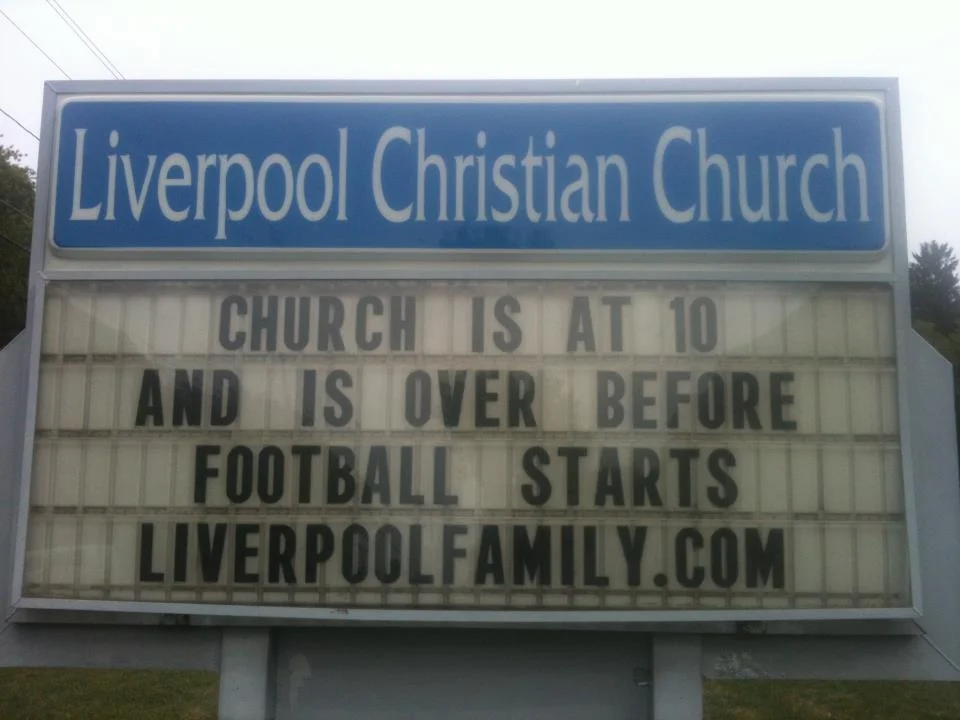
This church bulletin board applies to soccer, the other sports obsession around the world. But you can see our priorities
If football is better to you than Jesus, you don’t know the real Jesus.
It is instructive to see how often Jesus addressed common problems in terms of ultimate priorities. For instance, he once spoke about anxiety like this: “22 And he said to his disciples, “Therefore I tell you, do not be anxious about your life, what you will eat, nor about your body, what you will put on. 23 For life is more than food, and the body more than clothing.” (Luke 12:22-23) If you believe that the meaning of life consists in your basic bodily necessities, you will be driven to anxiety if there is even a chance that those needs may not be met. Jesus doesn’t just say, “don’t be anxious, its bad for you.” Or “I will provide for you, so don't worry.” Indeed he does say both. But he doesn’t leave it there. He gets to the root of the problem. Our anxiety comes from a lie, and we need to stop believing that lie. We need to stop believing that life is all about what we eat and what we wear. The NFL has a series of videos called a “football life,” and that title suggests where they want to position their sport in your thinking. Incidentally, you should remember that the NFL machine is a business. And like any good drug dealer, they want your whole life to revolve around their product. Thank God, Jesus can save you from that mindset. Is not life more than football, and the body more than your fantasy team?
Our hearts have a limited capacity. They can only love and focus on one thing. Jesus said, “No one can serve two masters, for either he will hate the one and love the other, or he will be devoted to the one and despise the other. You cannot serve God and money.” (Matt 5:24)
Why would Jesus say that no one CAN serve two masters? Because almost everyone tries to do this at some point. “I can serve Jesus and money…” We believe that by our will and wisdom we can manage this. But Jesus tells the truth. When the claims of 2 competing god’s want the same time slot, you will end up loving one and hating the other. The sad truth is that lots of men claim to love Jesus and football. But the truth is… they love football. And you can always tell this by looking at the scoreboard. Who is winning the battle of claims on the heart, wallet, and calendar?
How can you know if football is a false idol in your life? Here is the big idea, and I will try to expand on it in another post. If you are giving to football what belongs to God it is an idol. If you are giving to football what belongs to other priorities (like your family), it is an idol. In the next post I will offer some diagnostic questions and give some direction on what to do.
How To Be A Missionary To Your City

While few of us are full-time, vocational "missionaries" as the Apostle Paul was, we are all emissaries of Jesus and "sent" (that is the source word where we get the term missionary) to live for him in a hostile world. Every believer is salt and light (Matt 5:16) and we are to bring the grace of Jesus to our neighborhood, workplace, and family.
But how do you do that? There is much to say on this, but years ago I read a book on Church planting that mentioned these 5 things that I think encapsulated the big ideas of how the ordinary Christian functions as a missionary to their community. For a long time I had this printed on a sheet of paper above my desk.
In order to function as a missionary, you should enter your community as....
1. An Intercessor, praying for the City.
2. As a Learner, studying the city’s culture and history.
3. As a Servant to bring blessing and meet practical needs
4. As a Friend to make contacts and develop relationships.
5. As a Storyteller to share the gospel.
Join Us To Pray To End Abortion On Sept 27th
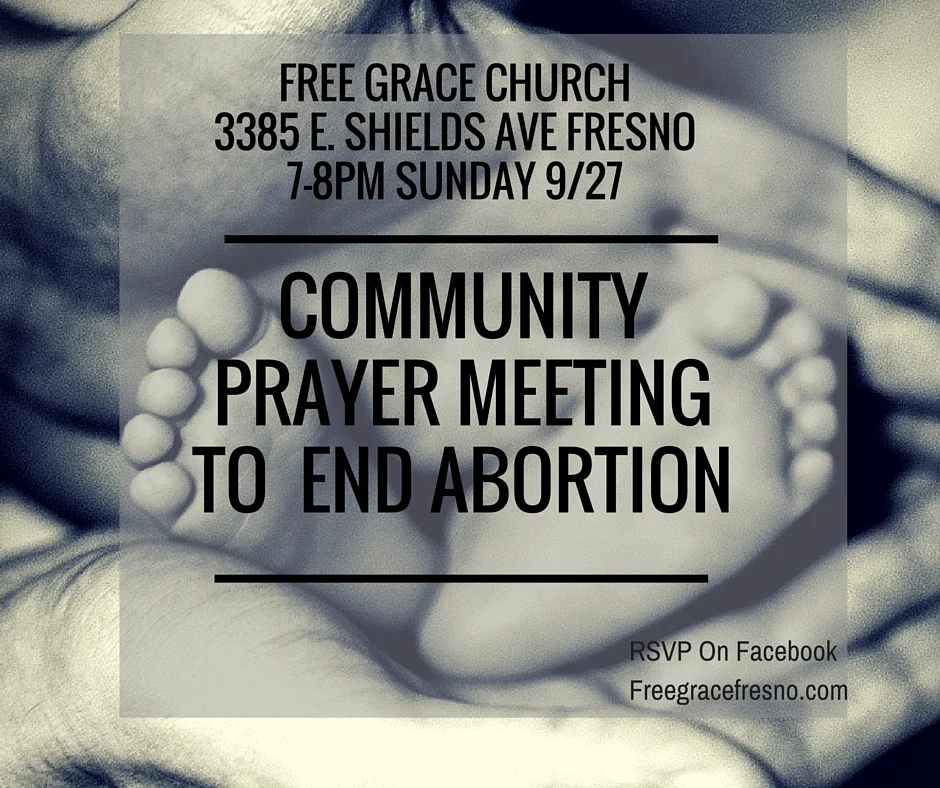
We will be having our 3rd community prayer meeting on Sunday night 9.27.15 at 7pm at our facility. We had 60 people from the community come last time, we are hoping for more. The continued release of videos (including one linked below) is opening a door to conversation on this issue like never before. Join us to pray.
We have a Facebook event page set up, RSVP here and share with others
Below is a brief commercial for the event, please share this on social media.
Here is the most recent video released by CMP documenting what Planned Parenthood has been doing.
Jesus, Friend of Sinners
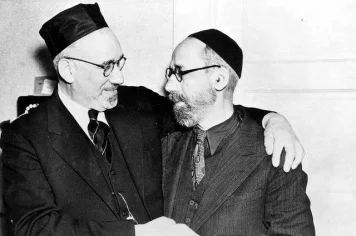
I was recently invited to give a devotional at a pastor's meeting where we discussing outreach and the importance of loving our neighbors. The general text of my talk is below:
Luke 5:27-32
27 After this he went out and saw a tax collector named Levi, sitting at the tax booth. And he said to him, “Follow me.” 28 And leaving everything, he rose and followed him.
29 And Levi made him a great feast in his house, and there was a large company of tax collectors and others reclining at table with them. 30 And the Pharisees and their scribes grumbled at his disciples, saying, “Why do you eat and drink with tax collectors and sinners?” 31 And Jesus answered them, “Those who are well have no need of a physician, but those who are sick. 32 I have not come to call the righteous but sinners to repentance.” (ESV Bible Translation)
In this passage, we see that Jesus has rescued Levi… one of the worst kinds of men, he was a tax collector. He was most likely a Jewish man, probably from the tribe of the priests. He should have been receiving tithes to fund worship in the house of God, instead he is a traitor… taking taxes to give to the Romans. And most tax collectors also committed extortion.
But Levi has come to follow Jesus. And he will become one of the most of the most influential men in the history of the church. He is the apostle Matthew. We still read his gospel. This is what Jesus Christ does, he takes the people that we look down on, people that are hopelessly corrupt and despised… and He saves them and gives them a great calling. He makes them sons and servants of God. This should give us hope. God might even use someone like you!
After Levi comes to follow Jesus, he is so overjoyed with his new relationship with Christ that he throws a party. He wants all of his friends to meet this Rabbi that is different than any other rabbi… Let me say this, the only way the people in our churches will ever do anything like this, is if they are so amazed and thrilled with Jesus Christ that he is their treasure.
So, Jesus is eating and drinking with tax collectors, and “Sinners." And the Pharisees protest, they ask the question in v. 30, “Why are you doing this?” Jesus is so close, and so friendly, with these awful people, there can only be one reason. He must be supporting them in their sin.
Jesus answers with his own mission statement in v. 32. He is like a doctor that came to help the sick. He didn’t come to help healthy people, but the lost and broken.
I would like to suggest that the Pharisees don’t really have a problem with WHAT Jesus is doing. The idea of telling these dirty sinners that they need to repent is probably OK with them. If he stood on the street and yelled at them, they would probably stand and cheer. No, Their problem is with HOW he is doing it. How is Jesus calling them to repentance? By eating and drinking with them. He has become friends with them, and through friendship calling them back to fellowship with God. His actions are a living parable of the message of the gospel. God makes his enemies to become his friends.
This doesn’t fit very nicely into our box does it! In many places in the church people live at the far ends of the spectrum.
Some embrace the lost and “sinners” by becoming friends with them. They want to love and support them, but they don’t offer them any medicine. In fact, they think that if you suggest that people are spiritually “sick”, then you must be judgmental.
On the other end there are Christians that want to call people to repentance, but they do it from a safe distance. They want to do it the way we are fighting terrorists, with drones. They do it by tract bombing, or doing “outreach” twice a year. They want to do it from a place of moral superiority. They are concerned that getting too close to lost people might get them dirty or damage their reputation. Though I have probably been guilty of both extremes, I think this second one is far more common among serious christians.
But Jesus does something different, he is able to receive and love people without endorsing or participating in their vices and sins. And he is able to call them to repentance, without alienating them or withdrawing from their company.
Brothers and sisters, this is our great salvation and our great example. And we will never be able to do this if we think we are the healthy and righteous ones. We will only be able to do this when we see that we are the sinners he came to call. When we see ourselves like Levi, completely beyond hope. But thrilled that we have a place at the table- that we have been loved and received by Grace.
I previously published this message at my blog at MattTroupe.net
Photo used courtesy of the University of Washington.
Something Important About The Harvest
Everything in scripture is equally true, but everything in scripture is not equally important. That is not trying to take away anything from scripture, but trying to reflect what the Bible teaches about itself. Some issues in the law are more "weighty" (Matt 23:23) than others. There are "greater" commandments (Matt 22:38). Paul said, "I determined to know nothing among you except Jesus Christ and him crucified (I Cor. 2:2).
So how do we know if something is really important? One way, among many, is to recognize when something is repeated again and again in a variety of contexts. That is exactly what we see with Jesus' remarks about the harvest and our responsibility to carry out the mission. He says some version of this 3 times, in 3 different situations. But with the same meaning and implications. How important is this?
Luke 10:2 "And he said to them, “The harvest is plentiful, but the laborers are few. Therefore pray earnestly to the Lord of the harvest to send out laborers into his harvest."
Matt 9:37 "Then he said to his disciples, “The harvest is plentiful, but the laborers are few; 38 therefore pray earnestly to the Lord of the harvest to send out laborers into his harvest.”
John 4:35- in the context of Jesus conversation with the Samaritan woman and the disciples question about why he is talking to her rather than worrying about lunch. "31 Meanwhile the disciples were urging him, saying, “Rabbi, eat.” 32 But he said to them, “I have food to eat that you do not know about.” 33 So the disciples said to one another, “Has anyone brought him something to eat?” 34 Jesus said to them, “My food is to do the will of him who sent me and to accomplish his work. 35 Do you not say, ‘There are yet four months, then comes the harvest’? Look, I tell you, lift up your eyes, and see that the fields are white for harvest. 36 Already the one who reaps is receiving wages and gathering fruit for eternal life, so that sower and reaper may rejoice together. 37 For here the saying holds true, ‘One sows and another reaps.’ 38 I sent you to reap that for which you did not labor. Others have labored, and you have entered into their labor.”
Christian Community Starts with the Work of Christ
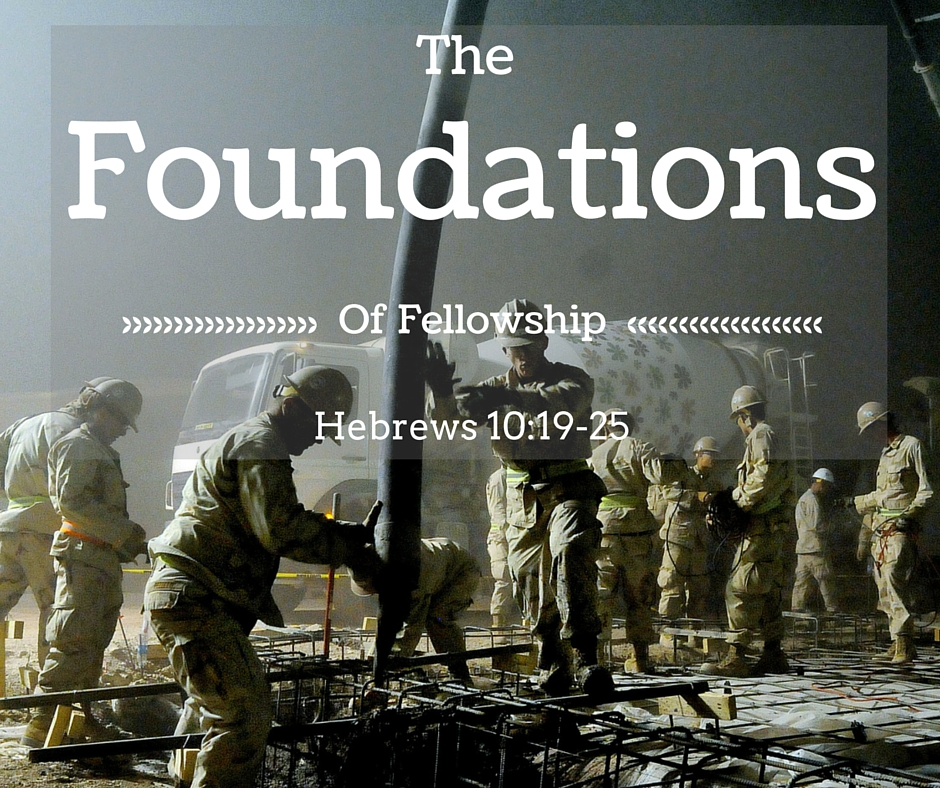
What are the key elements of Christian fellowship? How can we know if our Christian community is healthy? What keeps people from experiencing true fellowship? Is meeting together for fellowship really necessary? We looked at Hebrews 10 on Sunday as we relaunched our community groups.
Listen to the message here. There are some notes below.
Hebrews 10:19-39
“19 Therefore, brothers, since we have confidence to enter the holy places by the blood of Jesus, 20 by the new and living way that he opened for us through the curtain, that is, through his flesh, 21 and since we have a great priest over the house of God, 22 let us draw near with a true heart in full assurance of faith, with our hearts sprinkled clean from an evil conscience and our bodies washed with pure water. 23 Let us hold fast the confession of our hope without wavering, for he who promised is faithful. 24 And let us consider how to stir up one another to love and good works, 25 not neglecting to meet together, as is the habit of some, but encouraging one another, and all the more as you see the Day drawing near.”
Community starts with understanding what Christ has done for us. This is true because sin has separated us from God and one another. And the most important work, the first work is to repair the breach that our sin has caused between us and our God.
Sin separates us from God, and God from us. God’s righteousness has barred us from his presence. And because our consciences are defiled, being in the presence of God is no longer pleasurable. We now run from him rather than to him. The OT temple worship was a depiction of this situation. We are separated from God’s presence, but he has made a way for us to return and be cleansed.
The work of Jesus (especially v. 19-21), as described in this passage, shows us 4 things that are the foundation of Christian community. We cannot separate the way we relate to God from the way we relate to other people.
1. We are welcomed. We have bold access to God’s presence because of the sacrifice of Christ. His blood has cleansed us. We are no longer banished. This is not because we have become good enough or worked hard enough. This is purely because of his work on our behalf.
2. We are clean. Our hearts have been sprinkled by his blood. We are washed and forgiven and our consciences can be at peace. What the Old Testament animal sacrifices could only depict, Jesus has accomplished. We no longer need to be controlled by guilt and shame.
3. We are secure. A promise is only as good as the one who makes it, and we are safe and secure because he who promised is faithful.
4. We are in process. Though we are forgiven and accepted completely, there is much work to be done in us, on us, and through us. And this work is explained (in part) in this passage. God is at work in us through other believers. We desperately need them to help and encourage us.
So the exhortations of this passage show us that we need the following:
1. To stir one another up to love and good works. The term “stir up” that is used is really strong. It means to provoke. We are to have an active and engaging relationship with our brothers and sisters that helps us to become more loving, more Christ like. How in the world do you help someone become more loving? 2 ways: 1- by loving them in practical ways. 2- By explaining and reminding them of the love of Christ.
2. We are to consider how to stir one another up. Doing this is not as easy as we may suppose. We are going to have to spend time thinking about our brothers and sisters. Sin ties us in such knots that it is not easy to unravel. And God uses the patient, loving, prayerful relationships of his children to do his work in one another.
3. We are to meet together. This one is simple. We need to meet regularly, in face to face fellowship in order to do what this passage teaches. And if we were to make a graph of our fellowship, the shape of it would go upward. We should be doing this “more and more.” Meeting together for worship and fellowship is not an option; it is a vital part of God’s work in us. And we neglect it at our peril. There are no exceptions to this. Even if you are a soldier or a police officer and can’t attend normal worship on Sunday, you will need to discipline yourself to make other arrangements for worship and fellowship. If you neglect this, you threaten the health of your own soul and the church. Almost everyone that turns their back on Christ starts by turning their back on God’s people.
4. We are to encourage one another. This word is like a coin with 2 sides. Encouragement includes both admonition on the one hand (challenging one another and correction) and consolation on the other. This is something that others need from you. It is something that you need from others. In order to be healthy you need to give this and receive it. And this kind of fellowship can’t happen in a 10 minute conversation after worship. It will take time together.
And in the end, that is what the author concludes from the great work of Christ. It is all about relationship. We are to draw near to God in worship, and draw near to one another in fellowship. This is at the heart of what it means to be the church of Jesus.
Photo courtesy of the Navy Seabee Museum. Some Rights Reserved
What the Church Can Learn From A Rowing Team

Last week we had our second "FGC Talks" seminar. This means that after a brief worship service we had 3 brief sessions on the topic of community offered by 3 people in our church and one from outside. It was really fantastic.
Rob Hastie showed part of this video, posted below, (He showed from 1:00- 2:20 but the whole thing is worth watching). It is a trailer for the the book "the Boys in The Boat"- a story about the American rowing team that won the gold medal in the 1936 olympics. Rob uses the analogy of teamwork and how a successful rowing team has to operate with so much coordination and unity that they are really not 9 separate individuals. They are 1 team. This is a fantastic illustration for the way the church should be functioning.
Rob's talk is 20 minutes and worth listening to. It is an inspiring talk that will challenge you. You can listen to it below. The rest of our talks from that day can be found here.